Emotions Locked in Your Fascia: How Your Body Stores Feelings – and How to Set Them Free
Your body isn’t just a collection of muscles and bones. It is one vast, living electrical system: trillions of tiny batteries, your cells, constantly communicating through a shimmering web of fascia. In my years of practising and teaching MER® (Myofascial Energetic Release) I have seen something profound again and again: when we gently open the fascia, old emotions people thought were “just in their head” come flooding out, sometimes as tears, sometimes as a huge exhale, sometimes as pure laughter. The body has been carrying them the whole time.
Let me share how I understand the science behind it and, more importantly, how you can start releasing these stored emotions yourself.
Your body runs on electrons
Think of your body as a giant battery-powered city. Every cell needs a steady supply of electrons. Researchers in bioelectricity describe healthy cells running at around -20 to -25 millivolts and needing more charge, around -50 millivolts, to repair and make new cells. When voltage drops, repair slows, inflammation can linger and you feel flat, heavy or stuck.
Where do these electrons come from? These are your daily “chargers”:
- gentle, connected movement
- MER® myofascial bodywork
- infrared light (sunlight or sauna)
- structured (EZ) water
- time in nature and grounding, with bare feet on the earth
Fascia: a fast, semiconductive highway
Fascia is not just “packaging” around your muscles. It is a living, crystal-like matrix, one continuous sheet from the top of your head to the soles of your feet. Around every fascial fibre is what Dr. Gerald Pollack calls EZ (exclusion zone) water, a structured, negatively charged gel that he describes as acting like a battery and a highway for information and energy.
Fascia is also piezoelectric: it generates tiny electrical charges when gently compressed or stretched. So every touch, every breath and every slow movement creates micro-currents that support electron flow.
How emotions get stored in the body
Your body is electromagnetic, and every emotion has a physical signature. When you feel something fully, joy, anger, grief or fear, the energy moves through you and naturally discharges. But when emotions are overwhelming (trauma, shock, chronic stress, or childhood situations where it wasn’t safe to feel), the body protects you by holding them.
In my experience these unexpressed emotions become frozen patterns in the fascia. The tissue tightens, dehydrates and holds the “memory” of the original feeling, and the flow in that area drops. This is why old heartbreak can live in the chest for decades, childhood shame can sit in the jaw and shoulders, and deep fear can freeze the diaphragm so you never quite breathe fully.
Where emotions live in the fascia: your body map
Biofeedback, somatic research and clinical experience point to clear patterns:
- Anxiety: mainly in the chest and thorax (ribs, diaphragm, upper back). You feel tight and armoured, with shallow breathing: classic fight-or-flight holding.
- Sadness and grief: around the heart and mid-chest, sometimes the throat. That heavy “broken heart” feeling and collapsed posture.
- Depression: often a full-body shutdown, with heaviness, numbness and collapse from head to toe, like the whole system has gone into a freeze state.
- Fear: upper body and head: raised shoulders, tight neck and jaw, forehead and eyes. Chronic fear keeps the head forward and the chest guarded.
- Shame: head and face (eyes, forehead, cheeks), sometimes the upper chest. You want to hide, look down, disappear.
These aren’t random. They are intelligent protective patterns your body created to keep you safe when you couldn’t process the emotion in the moment.
What happens during an MER® session
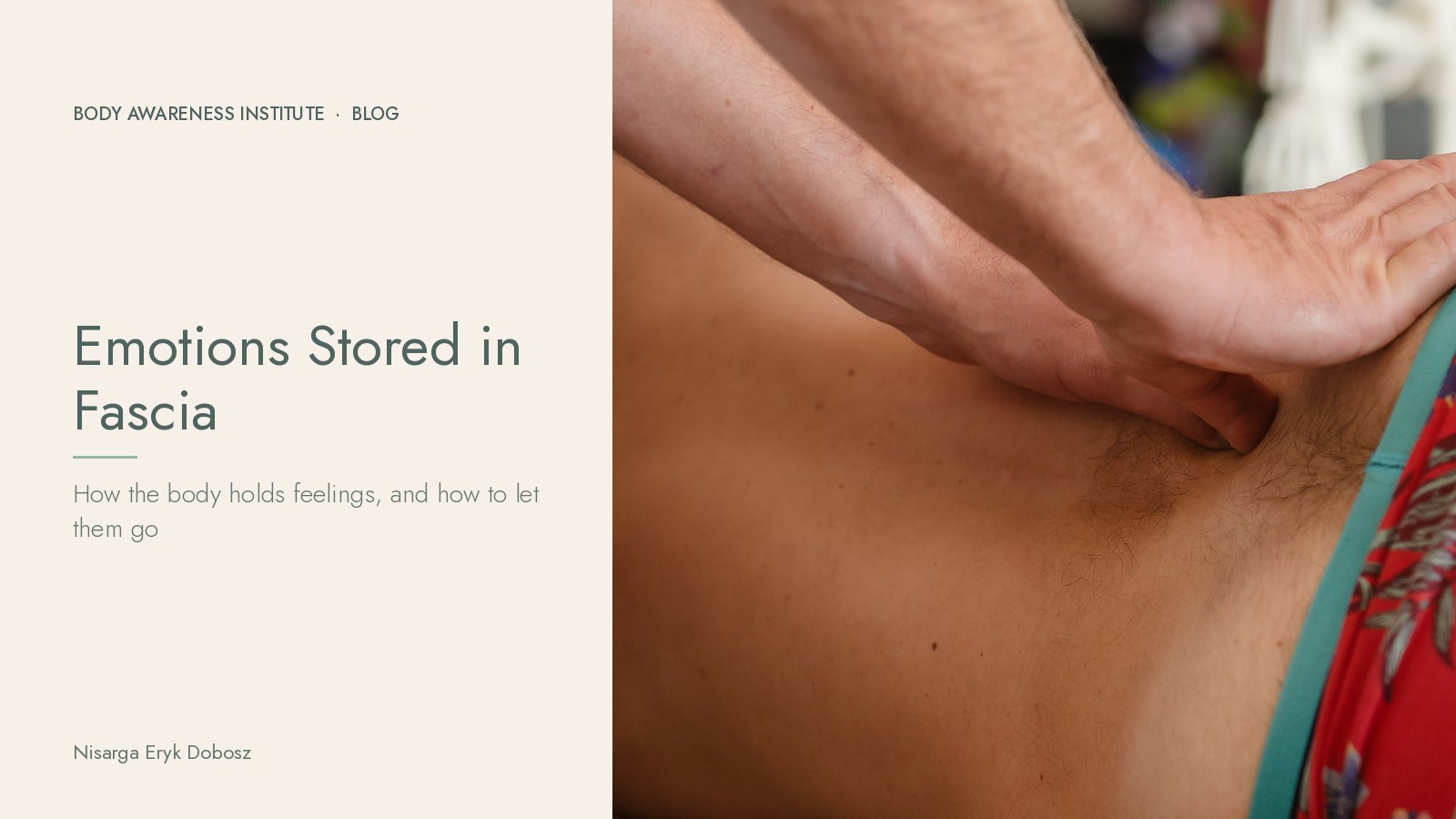
When I work with slow, listening touch, something beautiful happens. Sustained gentle pressure creates piezoelectric charges, the tissue rehydrates, lymph flows and the held pattern of the old emotion can finally discharge. People often cry, shake, laugh or sigh deeply. Colour returns to the face, shoulders drop and breathing deepens. They say: “I didn’t even know I was carrying that.”
So a session is not just a “massage”. It brings together nervous system co-regulation, gentle trauma discharge, lymphatic flow, myofascial reorganisation and the body’s own calming response. You can learn this work in our MER® training.
4 daily practices to release stored emotions
You don’t need a practitioner every day. Here are four gentle practices for home:
- The 3-minute emotional breath scan. Sit or lie down, one hand on your chest and one on your belly. Breathe slowly and ask silently: “What emotion is living here today?” Notice any tightness, heaviness, heat or numbness, and breathe into that spot for 10 slow breaths. No need to fix anything, just witness.
- A gentle fascia hold. Find a tight or tender spot (chest for grief or anxiety, jaw for fear, forehead for shame). Rest your palm or fingertips there with very light pressure and stay still for 2–3 minutes, breathing. You may feel warmth, pulsing, softening or emotions surfacing.
- Grounded emotional shake. Stand barefoot on grass or the floor and shake your arms, legs and whole body for 1–2 minutes, like a dog shaking off water. Then stand still and notice. This discharges stuck stress energy.
- Nature “electron bath”. Walk slowly in a forest or park for 20–40 minutes. Touch the trees and breathe deeply. Let the fresh air and sunlight recharge you. It is one of the most powerful daily chargers I know.
The invitation
Your fascia is not your enemy. It has loyally held everything you couldn’t feel at the time, protecting you until you were ready. Now you are.
Every time you move gently, breathe consciously, touch your body with kindness or spend time in nature, you help the fascia rehydrate and let old emotions finally complete their journey. The tears, the sighs, the spontaneous smiles are not weakness. They are the sound of your system coming back online.
Start small today. Pick one area that feels heavy, place your hand there, breathe and listen. Your body has been waiting to tell its story.
Go deeper with us
Explore the Biodynamic Breathwork & Trauma Release (BBTRS®) training and the Myofascial Energetic Release (MER®) training, see upcoming dates in Tallinn and Viljandi County in the calendar, or get our free ebook “The Issue Lives in the Tissue”.
Nisarga Eryk Dobosz is a bodyworker and trainer (BBTRS®, MER®, BCST, Lomi Lomi) and founder of the Body Awareness Institute. This article is for education and self-care. It is not medical advice and does not replace care from a doctor or therapist. It was first published on nisarga8.com.