Fascia: The Living Web That Holds Your Body, Your Movement and Your Story
After twenty-five years as a bodyworker and massage therapist, I can honestly say that my love for fascia only grows. Every year I touch it, study it, teach it – and every year it surprises me again. Fascia is a whole universe inside us, and it holds many keys to understanding how the body feels, moves and heals.
What is fascia?
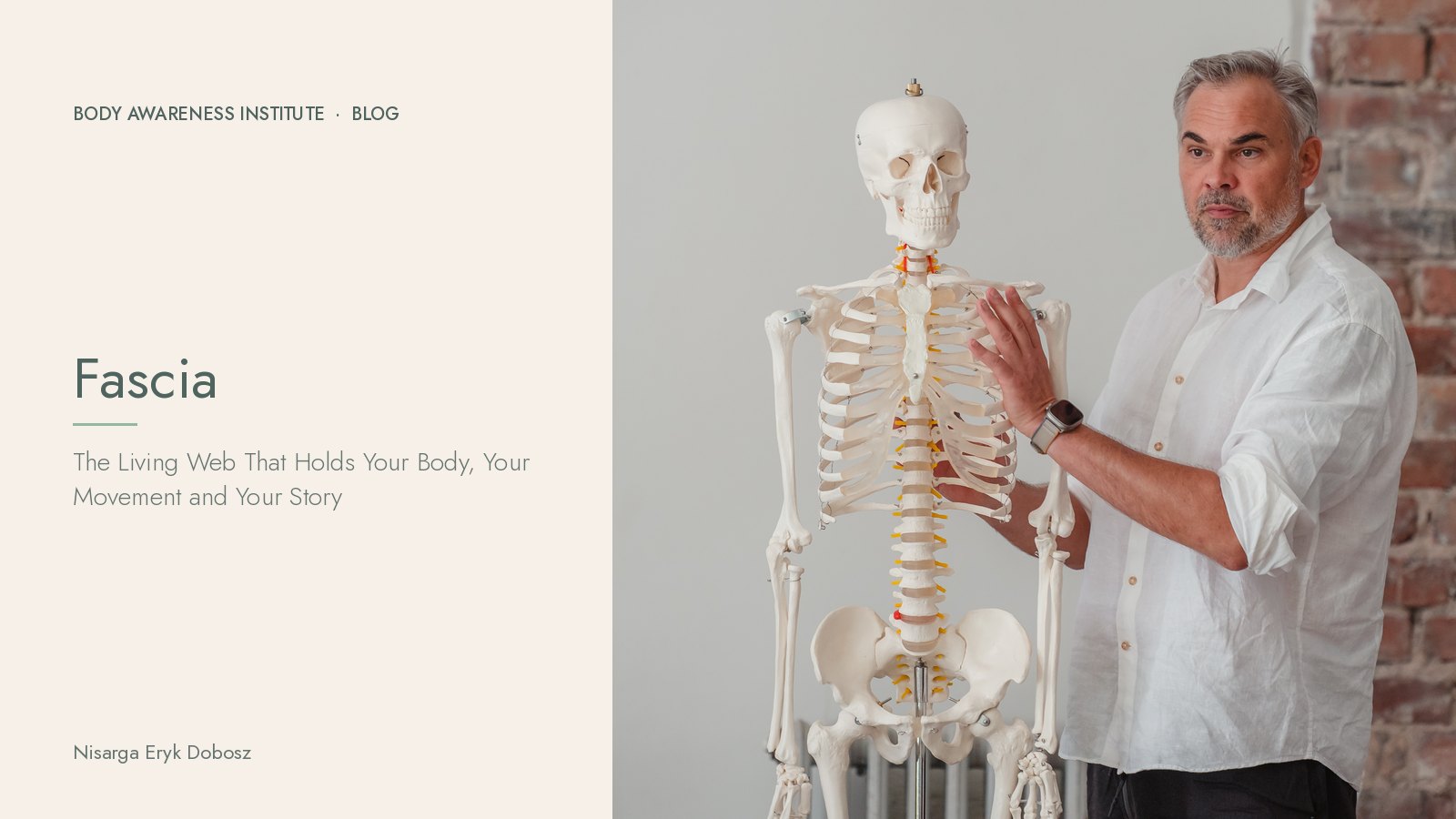
Fascia is connective tissue. In Estonian we say sidekude or simply fastsia. It is a three-dimensional web that wraps and connects everything in the body: every muscle and muscle fibre, bones, tendons, ligaments, nerves, blood vessels and all inner organs. If you could remove everything else and keep only the fascia, you would still see the complete shape of a human being.
Under a microscope fascia looks almost chaotic – fibres going in all directions – and yet it is perfectly organised. It is shiny, elastic, strong and full of fluid. It gives the body its form and at the same time allows us to bend, twist, reach and dance. It is the quiet architect behind every movement.
A short history
Modern interest in fascia began with Dr. Ida Rolf in the 1940s, the founder of Rolfing. Since then, many researchers and teachers – Robert Schleip, Tom Myers with his Anatomy Trains, Gil Hedley with his dissections, and Satyarthi Peloquin – have dedicated their lives to this tissue. Today fascia research is one of the most exciting fields in body science, and every year brings new findings.
What fascia does for you
Fascia is much more than "packaging". It is involved in:
- Proprioception – your sense of where your body is in space. Fascia is rich in nerve endings.
- Nociception – the sensing of pain and potential danger.
- Fluid and nutrient flow – it is a watery tissue, made of collagen, elastin, proteins and a lot of water.
- Balance and coordination – it transmits force across the whole body, so a tension in the foot can be felt in the neck.
And there is one more thing bodyworkers have known for a long time: fascia seems to hold the imprint of our experiences. Old injuries, long periods of stress, emotional shocks – they shape how the tissue holds itself. In bodywork we often say: "The issue is in the tissue."
Fascia, pain and stress
When fascia becomes dehydrated, stuck or thickened, we feel it as stiffness, reduced mobility and often pain. Over many years I have worked with many people with chronic lower back pain, neck and shoulder pain or headaches. Many of them experienced real relief and more freedom in movement through fascial work combined with breath and awareness. Some people living with migraine, plantar fasciitis, carpal tunnel syndrome or fibromyalgia also experienced relief.
I want to be honest and careful here: bodywork is not a cure and it does not replace your doctor. But the body has a strong natural tendency toward balance, and fascia, in a way, is always looking for health. When we give it the right conditions, it responds.
Because fascia is so connected to the nervous system, stress plays a big role. A body that is constantly in fight-or-flight holds itself tight. This is why, with clients who live with long-term stress or trauma, I first work to help the nervous system feel safe – to invite the calm, social state that, according to Stephen Porges' Polyvagal Theory, is called "ventral vagal". From safety, the tissue softens much more easily than under force.
Five things fascia loves
In my experience, five elements work together to keep fascia healthy:
- Touch – slow, listening touch like MER, myofascial release or good massage.
- Movement – varied, fluid movement, not only repetitive gym exercise.
- Emotional expression – allowing feelings to move instead of holding them in.
- Nutrition – what you eat builds the collagen of your tissues.
- Hydration – fascia is a fluid system; it needs water and movement to stay juicy.
Listening hands
In MER we learn to work with what we call "listening hands". We do not come with an agenda. We meet the tissue, wait, and follow where it leads. Pain points are often fulcrums – places where the body is asking for attention. When we listen with compassion instead of fighting the pain, the body begins to guide the process itself. It is a humbling and beautiful way of working.
Healthy fascia gives us a feeling of lightness – as if the body is lifted from inside instead of collapsing under gravity.
A 21-day fascia experiment
If you are curious to care for your own fascia, try this for 21 days:
- Every morning, give yourself 10–20 minutes for myofascial unwinding.
- Stand or sit, close your eyes, and let slow, continuous movements begin from the centre of your body.
- There is no right or wrong. Stretch, twist, roll, yawn. Follow what feels good, like a cat waking up.
- Breathe slowly through the nose and drink a glass of water afterwards.
Notice how your body feels after one week, and after three.
If you want deeper support, look for a trained MER practitioner for a session, or join one of our Myofascial Energetic Release trainings at the Body Awareness Institute in Estonia. Caring for your fascia can bring more mobility, more ease – and often more joy – into everyday life.
Go deeper with us
Explore the Biodynamic Breathwork & Trauma Release (BBTRS®) training and the Myofascial Energetic Release (MER®) training, see upcoming dates in Tallinn and Viljandi County in the calendar, or get our free ebook “The Issue Lives in the Tissue”.
Nisarga Eryk Dobosz is a bodyworker and trainer (BBTRS®, MER®, BCST, Lomi Lomi) and founder of the Body Awareness Institute. This article is for education and self-care. It is not medical advice and does not replace care from a doctor or therapist.