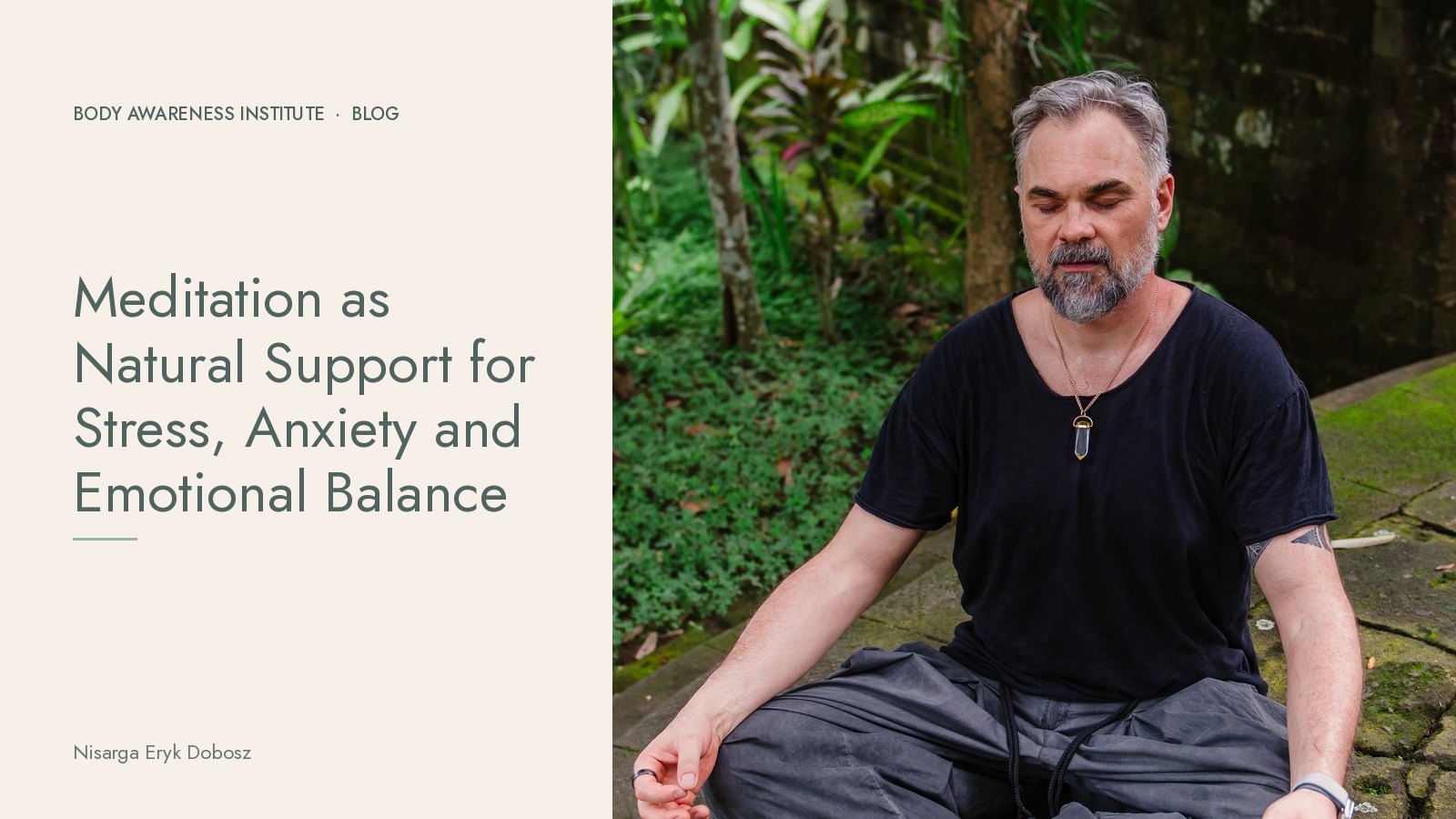
Meditation as Natural Support for Stress, Anxiety and Emotional Balance
Modern life moves fast. Emails, deadlines, news, notifications, children, bills. Even in a calm country like Estonia, many people tell me they feel constantly "on": tired but wired, unable to switch off, sleeping badly. Stress and anxiety have become our daily companions, and slowly we lose contact with ourselves.
In the middle of all this there is a very simple remedy, available to everyone, free of charge: meditation.
Meditation is self-regulation
For me meditation is not about sitting perfectly still or emptying the mind. It is a practice of self-regulation. We gently observe our thoughts, emotions and body sensations without judging them. We slow down. We become present. We truly feel what is happening.
In this way we become a witness to ourselves – to all the different parts of who we are. And from this witnessing comes a new clarity. Life's challenges don't disappear, but we meet them with more space and more grace.
Why it works on stress
When we are stressed, the sympathetic nervous system is in charge: heart rate goes up, breath becomes short and high in the chest, muscles tighten, digestion and sleep suffer. This is useful for a real emergency. But when it becomes the normal state, the body pays the price.
When we sit down, breathe slowly and turn our attention inward, the stress response begins to settle. The longer exhale, the softening belly, the stillness – they all send a signal to the body: you are safe now. The parasympathetic system, the "rest and digest" state, can come back. This is why I like to call meditation a natural support – not a cure for anything, but a daily nourishment for the nervous system.
Meeting yourself fully
Meditation also invites us to accept ourselves completely, with our vulnerability and our strength. When we sit in silence, we meet our deepest wounds and also our unique gifts. Both belong. From this comes a deep self-acceptance – and from self-acceptance comes inner peace.
In moments of real stillness, many people touch something bigger than themselves. Some call it the Divine, some call it nature, some call it simply peace. Whatever name you give it, it is a feeling of belonging to life.
Mindfulness in daily life
With regular practice we develop mindfulness: the ability to be fully here, in this moment. This becomes very practical. Instead of being carried away by an automatic reaction – snapping at a partner, scrolling the phone at 2 a.m., eating out of anxiety – we notice. We take one breath. And we can choose a more conscious, compassionate response.
This changes relationships – with ourselves, with our families, with colleagues.
Meeting the shadow
One of the most transformative sides of meditation is that it gives a safe space to meet our shadows – the parts of ourselves that we have pushed away. Shame, guilt, anger, fear, deep sadness.
When we sit with these feelings with openness and kindness, they slowly lose their grip. We don't need to fight them or analyse them. We let them be felt, breathed, held. And little by little, the weight becomes lighter.
Healing and emotional wellbeing are not about erasing emotions. They are about accepting them as part of being human. When we give ourselves permission to feel, there is room for growth.
Meditation through the body
Many people say: "I can't meditate, my mind is too busy." I understand – I felt the same when I started. This is why in my work I prefer body-based meditation. Instead of fighting the thoughts, we give the attention something to rest on: the breath, the feet, the heartbeat, the weight of the body.
For people with trauma or high anxiety, sitting silently with closed eyes can sometimes feel too much. Then it is completely fine to keep the eyes open, to walk, to move slowly, to shake, or to begin with active movement and let the silence come after. Find what feels safe for you.
A simple 10-minute practice
- Sit comfortably on a chair or cushion. Feel your feet or your seat on the ground.
- Let your eyes close, or rest softly on the floor.
- Breathe in through the nose for about four counts and out for about six. Let the exhale be long and soft.
- Feel the breath in the belly. Feel the body being breathed.
- When thoughts come – and they will – notice them, and gently come back to the breath.
- If an emotion comes, let it be there. Breathe with it.
- After 10 minutes, open your eyes slowly and notice how you feel.
Try it every day for three weeks, ideally in the morning or before sleep. Many people notice better sleep and calmer reactions after only a few days.
Not about perfection
Remember: in meditation there is no right or wrong way. It is about being present with yourself, again and again, with love. Some days it will be calm, some days restless. Both are meditation.
If you would like guidance, our breathwork and meditation sessions at the Body Awareness Institute in Tallinn are open for beginners too. You don't need any experience – just the wish to come back to yourself.
Go deeper with us
Explore the Biodynamic Breathwork & Trauma Release (BBTRS®) training and the Myofascial Energetic Release (MER®) training, see upcoming dates in Tallinn and Viljandi County in the calendar, or get our free ebook “The Issue Lives in the Tissue”.
Nisarga Eryk Dobosz is a bodyworker and trainer (BBTRS®, MER®, BCST, Lomi Lomi) and founder of the Body Awareness Institute. This article is for education and self-care. It is not medical advice and does not replace care from a doctor or therapist.