Not Pushing, Allowing: A Body-Based View on Trauma
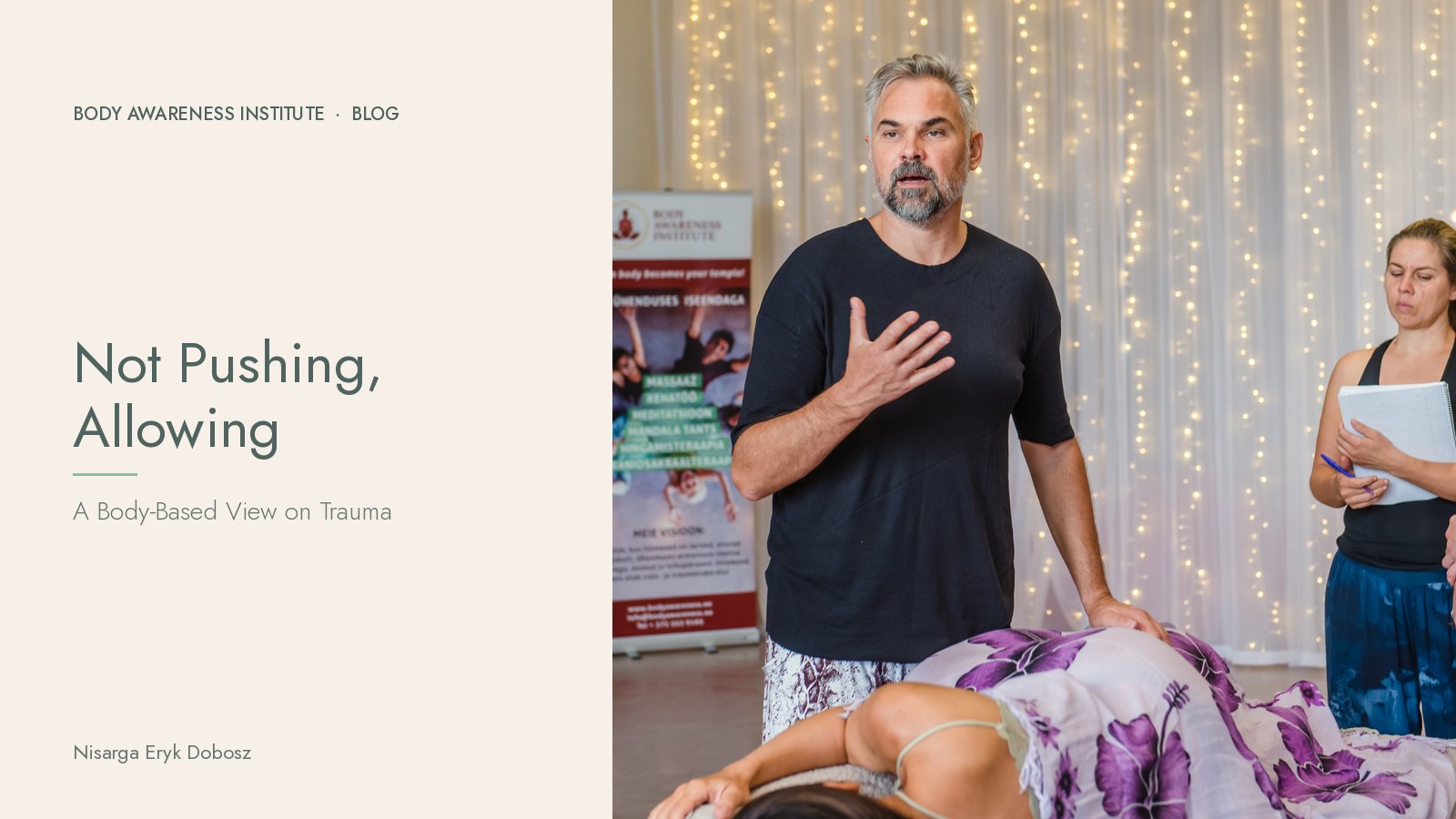
What does meaningful change look like in body-based trauma work? We can be drawn to the moments we can see: tears, shaking, a powerful expression of emotion. But the longer I work with people, the more interested I become in what is happening beneath that expression—and in what becomes possible afterwards.
Can the person remain connected to themselves? Can they feel safer in relationship? Can they pause before responding to someone they love?
My understanding has moved from a strong emphasis on catharsis towards a deeper respect for relationship, pacing and the client's own wisdom. Emotional expression can have a place. It is simply not the whole story. Sometimes the important movement is quiet: less force, more listening, and enough space for someone to discover their own next step. Not pushing. Allowing.
When I began my journey, I thought trauma recovery was largely about emotional expression. An intense session could look like important work because something visible was happening. My attention was drawn to catharsis and to helping people express feelings that had not found an outlet.
Through working with approaches including Biodynamic Breathwork, Myofascial Energetic Release, Compassionate Inquiry and NARM, that understanding became more nuanced. I started paying more attention to the relational field: what happens between practitioner and client, and whether the person feels safe enough to remain connected to their experience. That same orientation shapes how I teach trauma-informed bodywork and breathwork here in Tallinn, Estonia, and elsewhere.
I also became more interested in the difference between a familiar emotional response and what may be underneath it. A person can return to the same emotion again and again. They can express it intensely while remaining caught in an unconscious pattern. What I sometimes describe as a trauma vortex can look very active from the outside without necessarily bringing the person a different way of relating to themselves.
This changed the questions I asked about a session. Emotional expression alone did not tell me whether the person was becoming more regulated or gaining more capacity to be with their experience.
I have not rejected intensity. For some people, strong expression feels beneficial and helps release tension. But I have also seen that a cathartic approach does not suit everyone or necessarily widen what they can comfortably stay present with. The work needs to make room for those differences rather than ask every person to follow the same route.
For me, trauma release begins with safety and coming back to the body. It means returning to felt sense—to the ability to notice what is happening inside—and meeting parts of ourselves from which we have become disconnected. In body-based trauma work, fascia, breath and presence often matter more than forcing a dramatic breakthrough.
In my understanding of developmental trauma, some experiences are too much or too intense for us at the time. We develop ways of protecting ourselves. We may disconnect from a feeling, rely on control or organise ourselves around different protective parts. These responses have a purpose: they help us survive what we cannot yet hold.
That is why I am cautious about the language of simply letting go. It can sound as though there is something inside us that must be removed. I am more interested in becoming familiar with these parts, understanding what they have been protecting and meeting them with compassion.
There may be emotion beneath a defence. Making space for that emotion can be meaningful, but so can recognising the defence itself. We can begin to understand why we freeze in a particular situation, become angry or feel threatened in a relationship. Something in the present may be bringing us into contact with an older experience.
From this perspective, release is less about getting rid of a part of ourselves and more about changing our relationship with it. The question becomes: can I recognise this response, understand it more clearly and meet it with a little more love? That is a different orientation from trying to force a protective part to disappear.
Can healing happen without dramatic crying, shaking or screaming? In my experience, absolutely. I have seen meaningful moments arise when very little appears to be happening from the outside.
There can be a subtle, connected stillness after a period of activation. A person may begin to notice their inner experience more clearly. A realisation, an image or a memory may arise. They may recognise something about themselves or about a protective mechanism that they had not understood before.
These moments do not require an increasingly intense intervention. They may happen with a slow breath, slow movement, very light touch or time to reflect. The practitioner may be doing less, while the client is becoming more aware.
This does not mean that a quiet session is always more valuable than an expressive one. I also see people cry, shake or express feelings that have not previously had room. I want to leave space for that without making it the expected outcome.
“Less is more, especially when we work with trauma.”
In breathwork, bodywork and movement work, that principle keeps bringing me back to pace. Slowing the movement, slowing the breath or lightening the touch may offer something that more intensity does not. Nervous system regulation often grows from that kind of listening, not from pushing harder.
I also use approaches described as pendulation and titration: working with the movement between stillness and activation rather than staying at one level of intensity. For me, the ability to move between the two matters more than reaching a dramatic peak. It allows the work to follow the person rather than a picture of what a session is supposed to look like.
Co-regulation and self-regulation are both central to how I understand this work. A client does not arrive in an empty space. They arrive in a relationship with another person, and that relationship matters.
The client needs to feel that they can trust the practitioner. I often describe the connection between them as resonance. It is an ongoing sensitivity to the person in front of us: whether they feel heard, whether there is gentleness and whether there is room for their experience.
We are relational beings. We want to see and be seen, to feel contact and to be met by another person. When someone offers a compassionate presence, something inside us may begin to unwind. For me, that experience of being met is not separate from the work; it is part of it.
From there, the client can begin to develop ways of supporting themselves. In my practice, that may include meditation, gentle contact with the body, felt sense and different kinds of breathing. I mention coherent breathing as one example of the tools I use, rather than as a single answer for everyone.
The movement is from an experience of safety in relationship towards a greater ability to stay with oneself during activation. The client begins to recognise what is happening inside and learns ways of meeting it. I see these as connected aspects of the same process. The relationship offers a place to experience being supported; self-regulation helps the person bring some of that learning into moments when the practitioner is not there.
One of the most important distinctions in my work is between strong feeling with presence and strong feeling accompanied by a loss of connection.
I try to stay closely attuned to the client. The image I use is a radio: I am tuning to a particular wavelength. I pay attention to what the person shares, how they respond and what changes in their expression. It is a way of describing careful attention, not simply applying a technique and assuming I know what is happening.
A person may still be moving or expressing emotion while becoming less connected to themselves. The experience may be too much, too fast or too intense. What looks like a powerful process can instead become a moment in which the person's protective responses take over.
In my experience, warning signs can include fear or panic in the face and eyes, difficulty responding to a question, confusion about what is happening or a loss of orientation to where the person is. I describe this as losing the witnessing part of oneself: the capacity to feel something strongly while still knowing that one is here, experiencing it.
That is a reason to slow down rather than push for a bigger expression. I want to support the person's return to connection and become curious about what the protective response is doing. What is it trying to protect? What purpose has it served?
There is a very different quality between “I can feel tremendous rage or fear and remain present” and an explosion of rage in which someone loses themselves or gets hurt. I do not want to push a client towards shock or panic. More intensity is not automatically more useful work. The willingness to step back is part of the responsibility of holding the space.
For me, the results of body-based trauma work show up outside the therapy room. They appear in the person's relationships, in their family, among friends and colleagues, and in the ordinary situations that used to bring an automatic reaction.
People often come because their reactions trouble them. They want more intimacy, more peace or a more loving way of relating. The session can offer support and a place to learn, but those wishes concern life beyond the session.
I think about rush-hour traffic, an upsetting comment or an email that immediately brings up a strong reaction. Something begins to change when the person can pause, notice what is happening in the body and respond with more awareness. Sometimes the example I give is waiting twenty-four hours before replying to a triggering email. That time can allow a person to check in, feel the activation and make room for the emotions that accompany it. The point is the possibility of a pause rather than another automatic response.
A present relationship can sometimes reflect an older pattern. We may change partners, hoping that our reactions will change, and discover that something familiar is happening again. That can invite us to look at what we bring into the relationship and at experiences from much earlier in life that still influence us.
Taking the learning into daily life is what feels empowering to me. The person has more awareness of the pattern and more room to choose. The most meaningful sign may not be what they expressed during a session, but how they meet someone afterwards.
If I could emphasise one thing to facilitators, it would be the importance of giving the client space. We can become so involved in doing that we stop listening closely enough to the person.
There is a temptation to show the way, give advice or decide what will be good for someone. I recognise that temptation. In bodywork especially, there can be a strong orientation towards fixing and aligning. The practitioner is doing something, and it is easy to become attached to the idea that this doing must lead the process.
But I find it powerful when the client can guide the next step: when there is enough room for them to discover what they need to explore and to communicate that within the relationship.
For me, less is more is not an argument for indifference. It is an invitation to notice when our own activity or certainty is filling the space. Can we step back from our idea of what should happen and listen to what this person is actually bringing? The client does not need to become a demonstration of the practitioner's method. I want the relationship to leave room for the person's own discovery.
My own development keeps moving towards trust. The more I work with people, the more I want to trust the client's wisdom to find their way.
This has been a long process. My background in Biodynamic Breathwork & Trauma Release and Myofascial Energetic Release has given me many ways to work, but it has also brought me into contact with my own impulse to fix. Increasingly, I notice those moments and try to step back from them.
I want to offer a present, compassionate space without placing my personality or my expectation of an outcome over the client's experience. Everyone has a different story and a different pace. The work asks me to keep remembering that, not just to understand it as an idea.
“The more I work with people, the more I lean towards trust.”
That is where these reflections come together for me. Emotional expression can matter, but so can stillness. Relationship can support us, and we can learn to meet more of our own experience. A session can be meaningful, and its meaning may become clearer later, in an ordinary moment of daily life.
Ultimately, I am interested in that growing space: the space to feel without losing ourselves, to relate with more awareness and to respond with more choice. A body-based view on trauma, for me, keeps returning to the same invitation—not pushing, allowing.
If this way of working resonates and you would like to explore trainings or ask a question, you are welcome to get in touch with Body Awareness Institute. You can also browse upcoming dates in the calendar, including Myofascial Energetic Release modules in Tallinn. There is no online checkout—we read each message personally and reply with the details.
Go deeper with us
Explore the Biodynamic Breathwork & Trauma Release (BBTRS®) training and the Myofascial Energetic Release (MER®) training, see upcoming dates in Tallinn and Viljandi County in the calendar, or get our free ebook “The Issue Lives in the Tissue”.
Nisarga Eryk Dobosz is a bodyworker and trainer (BBTRS®, MER®, BCST, Lomi Lomi) and founder of the Body Awareness Institute. This article is for education and self-care. It is not medical advice and does not replace care from a doctor or therapist.